
Seminole, Texas · Gaines County · Permian Basin
Scorpions gone. Termites stopped.
The lot cleared.
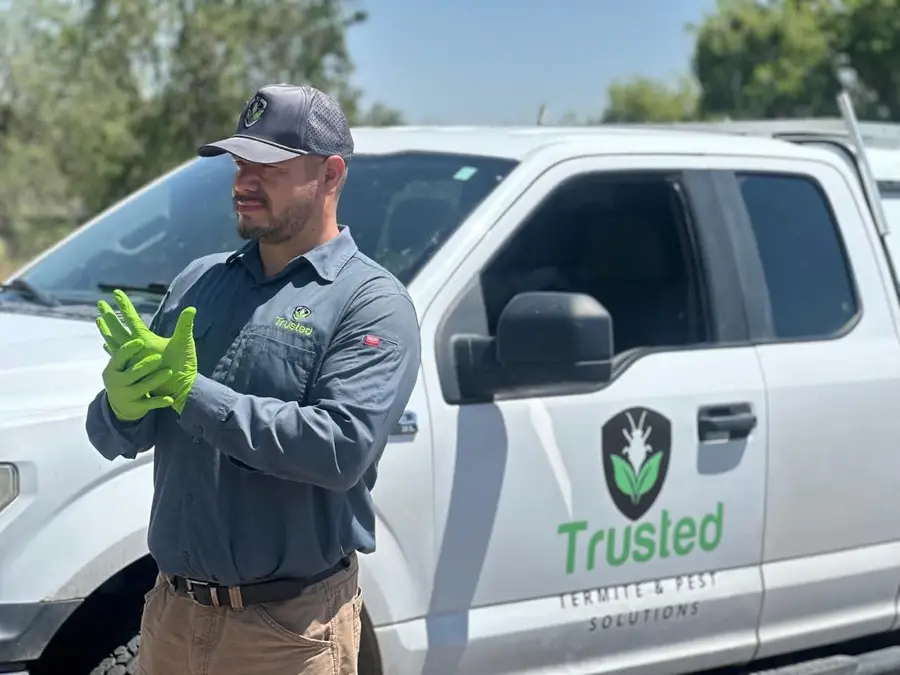
One licensed owner-operator, based in Seminole — not a route driver sent out from Odessa or Lubbock. Pest control, termite work, lawn and brush, and junk removal on one invoice.
Valentin Moriel holds Texas Department of Agriculture licence TPCL 0976265 across four categories, has six years in the trade, and grew up here. He inspects before he quotes, he explains what he thinks is happening and what it will cost before anybody books anything, and and he answers his own phone about nine times out of ten. Nothing gets treated that has not been looked at first. There is no contract on any service, and the guarantee has a real number in it rather than a slogan.
Trusted Termite and Pest Solutions is a locally owned pest control, lawn and junk removal company based in Seminole, Texas, serving Gaines County and the Permian Basin. Owner Valentin Moriel holds Texas Department of Agriculture licence TPCL 0976265 in pest control, termite, lawn and weed categories.
What we do
Recurring Pest Control
Bi-monthly or quarterly service that keeps ahead of pressure instead of reacting to it. Complimentary re-services between visits for covered pests.
Scorpion Control & Exclusion
Sealing and treatment aimed at where striped bark scorpions actually get in — weep holes, utility penetrations, the water heater closet and the irrigation box.
Termite Treatment
Liquid barrier treatment, Trelona bait systems, and new-construction pre-treats. Individually quoted after an inspection — linear footage, foundation type, soil and access all change the job.
Rodent Control & Exclusion
Trapping, professional bait stations, monitoring and — the part that actually ends it — sealing the ways they get in.
Lawn Care & Weed Control
Mowing, trimming and edging, fertilization, tree trimming and weed spraying, priced on the property rather than a flat rate.
Brush & Lot Clearing
Overgrown lots, fence lines and acreage cleared and hauled — including properties under a city or county notice.
Junk Removal & Property Cleanouts
Junk hauls, full property cleanouts, and ongoing upkeep for owners who are not local. Priced on volume, material and disposal.
Why people call us instead of the big outfits
Valentin Moriel spent six years running operations and service for pest control branches in El Paso, including a Terminix-Rentokil branch, before starting this company in Seminole — the town he grew up in and graduated high school in. He is direct about what that taught him:
"Big companies can make customers feel like just another number. You get passed around, put on hold, and rarely talk to the same person twice. That's actually the environment I came from, and it helped shape what I didn't want my company to become."
So: he answers his own phone. He inspects before he quotes. He explains what he thinks is happening and what it costs before anybody books anything. There is no contract to sign, and the guarantee has a number on it rather than a slogan.
Where we work
Seminole is home. From there the route runs out roughly a hundred miles in every direction — north to Seagraves and Brownfield, west to Denver City, south to Andrews and Odessa, east to Lamesa and Midland, and northeast to Lubbock.
Seminole, TX
Gaines County · home
Seagraves, TX
Gaines County · about 16 miles northeast
Denver City, TX
Yoakum County · about 22 miles northwest
Andrews, TX
Andrews County · about 40 miles south
Lamesa, TX
Dawson County · about 41 miles east
Brownfield, TX
Terry County · about 41 miles north-northeast
Big Spring, TX
Howard County · about 95 miles southeast
Midland, TX
Midland County · about 75 miles southeast
Odessa, TX
Ector County · about 90 miles southeast
Lubbock, TX
Lubbock County · about 75 miles northeast
Kermit, TX
Winkler County · about 85 miles south-west
Stanton, TX
Martin County · about 90 miles south-east
Three services, one invoice, one person
Pest control, lawn and brush, junk removal. No other company in this market does all three, and it is not a bundling gimmick — it is that out here they are frequently the same job.
Texas A&M AgriLife's own list of what striped bark scorpions shelter under reads: rocks, boards, debris, dead vegetation and fallen logs. That is a description of a West Texas side yard. The brush pile from last year's trimming, the stack of lumber left over from a project, the old cooler behind the shed — every one of those is harbourage sitting a few feet from the foundation. You can spray the perimeter every quarter and it will keep coming back, because the thing producing the problem never moved.
Split across two companies, it gets half done. The company that hauls does not treat. The company that treats works around the pile and does not mention it. Here it is one visit: the debris goes, and the ground it was sitting on gets treated before anybody leaves.
The same logic runs through the lawn side. Several cities on this route enforce weed and nuisance standards with real deadlines and real money attached — Lubbock at eight inches with a $175 administrative fee, Odessa at twelve with equipment and labour billed hourly, Midland at eighteen, Andrews at twelve on smaller lots. Outside city limits, Texas Health & Safety Code §343.011(c)(4) defines the nuisance by proximity rather than by height — weeds within three hundred feet of another residence or commercial establishment, with no inch figure in the statute at all. If you have had a notice from the city, the clearing and the pest problem are usually the same conversation.
What is actually different about West Texas
Most pest control advice on the internet was written for somewhere wetter. A few things here genuinely do not match it.
Scorpions are the real headline pest. Not termites, not roaches — the striped bark scorpion, and it peaks in July and August. AgriLife's extension entomologists note that they move indoors when it gets excessively dry outside, which makes a drought a better predictor than a calendar. It also means the right time to seal a house is before the dry stretch, not during it.
You probably do not have the termite you think you have. AgriLife notes that subterranean termites decrease moving inland and are noticed less often in the High Plains and far West Texas. Formosan and drywood termites do not occur here. What does occur is the arid-land subterranean termite and the desert termite — and the desert termite eats dead grass, not houses. The white carton sheeting that turns up on a lawn after a summer storm is usually that, and it is not a structural emergency. Real termite risk exists here and still needs inspecting properly. It just should not be sold out of fear.
Those are probably not fire ants. Gaines, Andrews, Yoakum and Dawson counties are not on the Texas Department of Agriculture fire ant quarantine list. Midland, Ector, Howard and Winkler are; part of Lubbock County is. If you are in Seminole looking at a mound with a bare circle three to six feet across and trails running out of it, that is almost certainly a red harvester ant — which stings, but per AgriLife does not invade houses. Different problem, different treatment.
The ground changes town to town. Around Seminole, Seagraves and Andrews it is sandy soil, caliche and areas with a mix of clay — some properties on very loose sand, others with extremely hard caliche layers, and new construction often on disturbed or imported fill. Soil determines drainage, movement and how a structure meets the ground, which is most of what decides termite risk. Sixty miles away in Midland it is a different answer.
What it costs
Nobody else in this market publishes a rate. We would rather you knew before you called:
- Recurring pest control: around $140–$160+ per visit, depending on the size of the home, the pressure and how often you want service
- Initial service: $200–$250 — longer, because it sets the baseline
- Termite, bed bug, mosquito, lawn, brush and junk: individually quoted after somebody has looked at it
- No contracts. Bi-monthly or quarterly, stop whenever you want
- Military discount. That is the one we offer, and one real discount beats a page of them
That sits toward the top of the West Texas range rather than the bottom, and that is deliberate. The cheapest quote in this market is usually somebody's fourth stop of the morning on a timed route. The quote you are given is the number you pay.
The guarantee, with a number in it
Thirty days. If a pest included in your treatment is still active within thirty days of service, we come back, inspect and re-treat the affected area at no additional charge. Recurring customers also get re-services between scheduled visits for covered pests — if something comes up, call rather than waiting for the next appointment.
It does not cover a new or different pest problem, conditions outside the scope of the original service, or specialty work — termites, bed bugs, rodents, wildlife, fleas and ticks each carry their own terms. Termite treatments come with a separate one-year re-treatment warranty that covers re-treatment and not structural damage or repairs.
All of that is written down on one page, including the exclusions. A guarantee you cannot be held to is not worth having, which is why "100% satisfaction" is not what we say.
Through the year in West Texas
Weather moves the season around more than the calendar does — a warm winter, heavy rain, drought, irrigation or a sudden temperature swing can change what is showing up from one month to the next. But the shape of the year is reasonably consistent, and knowing it is most of what separates staying ahead of a problem from reacting to one.
January and February are slower for insects — mostly rodents, cockroaches and anything looking for somewhere warm. It is the best window of the year to do exclusion work properly, because nobody is in a hurry and sealing holds all year once it is done.
March and April bring warmer ground and a general wake-up: ants, spiders and termites all become more active. This is the front end of the termite window here, and it overlaps with real-estate season.
May and June is when it genuinely picks up — ants, termites, spiders, wasps, fleas and ticks together. A plan started now is doing its job by the time July arrives. A plan started in July is playing catch-up.
June through August are the busiest months of the year. Heavy scorpion activity on top of everything else. Desert termites also throw carton sheeting onto lawns after summer storms, which alarms people and almost never means what they think it means.
September and October stay active, because it holds its heat well into the fall. Then as temperatures drop through October and November, rodents move toward buildings — houses, but also barns, shops and equipment yards. Harvest moves them too. This is the natural window for brush clearing and hauling off what accumulated over summer.
December shifts back indoors, plus attic and shed cleanouts. Texas DSHS flags cleaning areas where rodents have been living as a genuine risk, which is why a shed cleanout gets treated as a job with precautions rather than a job with a trailer.
Two things sit outside the calendar. Bed bugs are not seasonal — those calls come at any point in the year. And termites depend so heavily on soil, moisture and the individual property that the calendar alone tells you very little.
Commercial work
Recurring plans run for commercial property as well as homes — apartments and property management, restaurants and food service, hotels and motels, warehouses, retail and offices. That list is what has actually been worked, not everything a pest company could theoretically service.
If you manage rental property in Texas, two rules are worth knowing. Property Code §92.052 requires landlords to make diligent efforts to repair conditions that materially affect the physical health or safety of an ordinary tenant, and pest problems can qualify. And under 4 TAC §7.146, a licensee must provide a pest control sign at least 48 hours before a planned indoor treatment at residential rental property with five or more units, and at workplaces, hotels, warehouses, food-processing facilities, schools and day care centres. The Texas Department of Agriculture issues an official Spanish version of that notice, and it goes up where that is the language of the house.
Between them that is a duty to fix and a notice obligation you need a vendor who knows about. It is a fair question to ask any company you are considering.
What we do not do
Worth saying, because a company that claims everything is telling you something:
- No fumigation. Not offered, and not licensed for it — Structural Fumigation is a separate TDA category.
- No bed bug heat treatment. Chemical treatment only. If a job genuinely needs heat, you will be told that rather than sold something that will not do it.
- No landscaping, dumpster rental, pressure washing or demolition. Mowing, trimming, brush and lot clearing, weed spraying, fertilization, tree trimming, junk hauls and property cleanouts — yes. Those other four, no.
If you need one of those, we will say so and you can go find somebody who does it properly rather than have us learn on your property.
Se habla español
Valentin habla español con fluidez. Casi la mitad de Seminole habla un idioma distinto del inglés en casa, y ninguna otra compañía de control de plagas en esta zona ofrece servicio en español directamente con el dueño.
Puede llamar o enviar un mensaje de texto al (432) 278-7294 y hablar directamente con él — no con una central de llamadas, y no con alguien que tenga que buscar a un traductor.
How to get a straight answer out of any pest company
Including this one. Most of what goes wrong in this trade happens because a homeowner has no way to check what they are being told, so here are the questions that actually separate companies:
- What is your Texas licence number, and which categories are on it? Pest Control, Termite Control, Lawn & Ornamental and Weed Control are four separate TDA categories. A pest control licence does not authorise termite work, and neither authorises weed spraying. Ours is TPCL 0976265 and it covers all four.
- Which species do you think this is, and how do you know? "Termites" is not an answer in a region where one of the common species eats grass rather than wood.
- What am I getting in writing before you treat? Texas requires a written estimate carrying the business licence number, a diagram with perimeter measurements, product labels and concentrations, complete warranty details and a consumer information sheet before termite treatment begins.
- Does the warranty cover re-treatment or damage? They are very different promises and the second one is rare. Get it in writing either way.
- Who is actually turning up? Worth asking, because on most routes it will not be the person you spoke to.
If a company gets cagey about any of that, it tells you what you need to know without anybody having to be rude about it.
One more worth knowing, because it comes up on every real-estate transaction here: in Texas, a Wood Destroying Insect report — the official T-5 form — can only be completed by a certified applicator or a technician licensed specifically in the termite control category. It is a hard credential gate, not a formality, and the requirement to have one usually comes from the lender or the contract rather than from state law. If somebody tells you Texas law requires it in every sale, they have not read the rule.
Common questions
What areas do you cover?
Seminole and Gaines County first, then Seagraves, Denver City, Andrews, Brownfield, Lamesa, Big Spring, Midland, Odessa and Lubbock. Roughly a hundred miles from Seminole. There is no trip fee, though job minimums get discussed for out-of-town work.
Do you make me sign a contract?
No. There are no contracts on any service. Recurring plans are bi-monthly or quarterly and you can stop them whenever you want. What holds people is the work, not the paperwork.
How much is pest control?
Recurring residential service generally runs $140 to $160 or more per visit depending on the size of the home, the pest pressure and the frequency. The initial service is usually $200 to $250 because the first visit is more extensive. Termite, bed bug, mosquito, lawn and junk work is individually quoted after we look at it.
Who actually shows up?
Valentin Moriel, the owner. This is a one-man operation on purpose — he holds Texas Department of Agriculture licence TPCL 0976265 as a Commercial Certified Applicator, and he does the work himself rather than sending somebody on a timed route.
Can you come out today or tomorrow?
Often, yes. It depends on the schedule and where you are, but we keep enough flexibility to offer same-day or next-day service when we can. Call and we will tell you the earliest we can actually be there.
What is the guarantee?
A 30-day service guarantee. If a pest included in your original treatment is still active within thirty days of service, we come back, inspect and re-treat the affected area at no additional charge. Recurring plan customers also get re-services between scheduled visits for covered pests.
Talk to Valentin
He answers his own phone. Tell him what you are seeing, where you are seeing it and how long it has been going on, and he will tell you what he thinks it is and what it costs before anyone books anything.