
The person doing the work
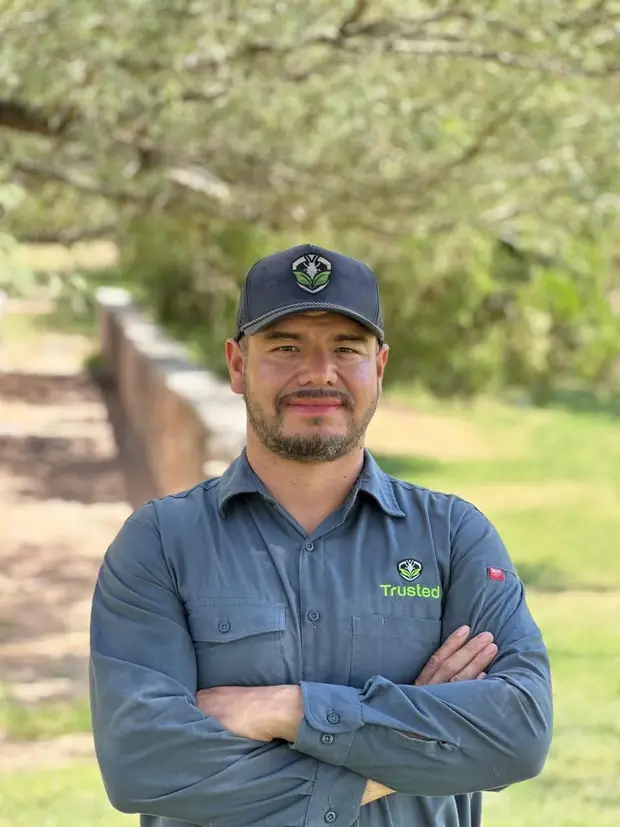
Valentin Moriel
Valentin Moriel owns and operates Trusted Termite and Pest Solutions in Seminole, Texas. He holds Texas Department of Agriculture licence TPCL 0976265 as a Commercial Certified Applicator in pest control, termite, lawn and weed categories, and has worked in the trade six years.
How he got into it
"About six years ago, I was recruited by my former district manager from a previous job to become the Operations Manager of a small pest control branch. I came into the industry from a management and operations background, and because of the position I stepped into, it really became a fast track for me to learn and grow in the industry. I wasn't only learning pest control — I was involved in virtually every side of the operation, from managing technicians and working directly with customers to solving difficult pest problems, sales, training, and the day-to-day operation of the branch."
That was in El Paso, across two branches including Terminix-Rentokil, over six years. It gave him both sides of the job — the technical side and the business side — and it gave him a clear view of what large-scale pest control does well and what it does badly.
Why Seminole
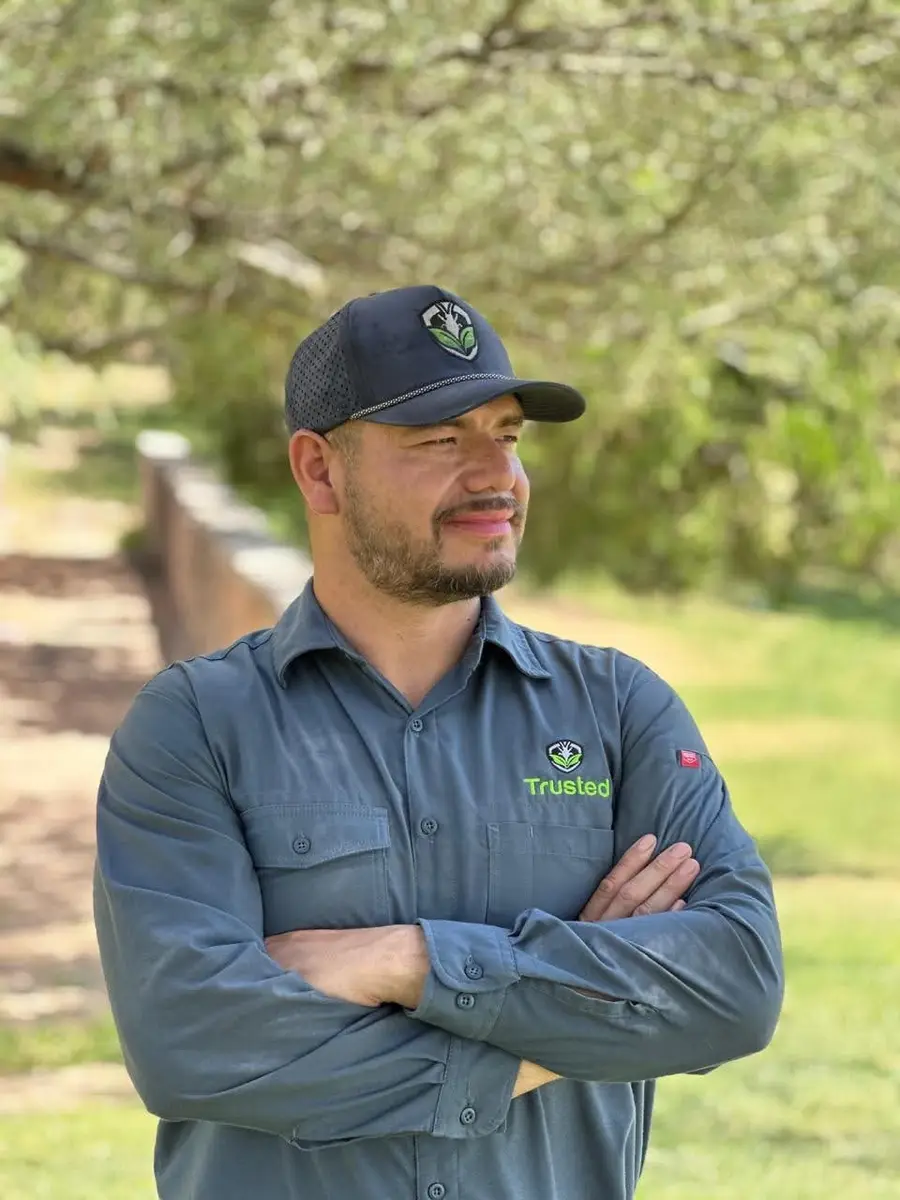
Because he is from here. He grew up in Seminole and graduated high school here, and has been in and out of Gaines County his whole life. Trusted Termite and Pest Solutions started in November 2025, and it is deliberately a one-man operation: the person who picks up the phone is the person who shows up, inspects the property and does the treatment.
On what he took away from working at scale: "Big companies can make customers feel like just another number. You get passed around, put on hold, and rarely talk to the same person twice. That's actually the environment I came from, and it helped shape what I didn't want my company to become. We want to know our customers, take the time to understand their concerns, and service their property correctly — not rush through a timed service just to get to the next stop."
Licence and credentials
- Texas Department of Agriculture Structural Pest Control Licence TPCL 0976265
- Commercial Certified Applicator
- Licensed categories: Pest Control, Termite Control, Lawn & Ornamental, Weed Control
- Insured — Markel, $500,000 bodily injury and property damage, $1,000,000 aggregate
- 6 years in the trade
- Fluent in English and Spanish
Texas requires the business licence number on the face of every contract, warranty, service agreement and guarantee, and on every invoice, under 4 TAC §7.145 — and on written estimates for termite work under §7.174. Very few pest control companies in West Texas publish theirs anywhere else. You can verify it with the Texas Department of Agriculture.
What the licence actually means
Most people have never had a reason to learn how pest control licensing works in Texas, and the industry does very little to explain it. It is worth knowing, because the difference between the licence classes is the difference between someone who can legally make decisions about your property and someone who cannot.
Structural pest control in Texas is regulated by the Texas Department of Agriculture under the Structural Pest Control Service. There are three working credentials. A technician can apply pesticide under supervision. A certified applicator can apply and can supervise technicians. A responsible certified applicator is the one individual a business designates for a given location, responsible under 4 TAC §7.121(b) for the training and supervision of all pest control operations there — and a person may hold that role for only one business location at a time.
Valentin holds the third one. In a branch operation, that person is usually a manager sitting in an office who signs off on work done by other people. Here, it is the person standing on your property with the equipment. There is no gap between the licence and the work, because they are the same person. That is not marketing — it is a structural fact about a one-man business, and it is the single most useful thing to understand about how this company differs from the branches.
The licence is category-based rather than general. Holding it in pest control does not automatically confer termite. Each category is separately examined and separately maintained. The four he holds — pest control, termite, lawn and ornamental, and weed control — are the ones that cover essentially everything a residential or light commercial property in this region needs outside of fumigation, which requires its own certification and which he does not hold and does not pretend to.
Licences are not permanent. Continuing education is required to maintain them, on a fixed cycle, in the specific categories held. A licence that lapses is not a paperwork problem, it is an illegal application. This is one of the reasons the number is published here: it can be checked against the Department's own records, by you, at any time, without asking us anything.
How to verify it yourself
Search the Texas Department of Agriculture's structural pest control licence records for the number TPCL 0976265. (How the licence classes and categories work, if you want the full picture.) You are looking for three things: that the licence exists, that it is current rather than expired or suspended, and that the categories listed match the work you are about to pay for. If someone quotes you a termite job, the termite category needs to be on their licence. If it is not, the quote is not a quote — it is a problem waiting to become yours.
Do this for anybody you are considering, not just for us. It takes about two minutes and it is the only piece of due diligence in this industry that is both free and conclusive. Reviews can be bought. Photographs can be stock. A licence record is a licence record.
If a company will not give you a licence number when asked, that is the answer. There is no legitimate reason to withhold it. Texas already requires it on written estimates, so anyone declining to say it out loud is declining to do something they are going to have to do anyway.
What the insurance covers, and what it does not
General liability at $500,000 per occurrence for bodily injury and property damage, $1,000,000 aggregate, carried with Markel. In plain terms: if something is damaged or someone is injured in the course of the work, there is coverage behind it rather than a conversation about who pays.
What it is not: it is not a bond, and we do not describe ourselves as bonded, because that word means something specific and we are not going to borrow it. It is also not a warranty on the pest outcome — that is a separate thing, covered on the guarantee page, and conflating the two is a trick the industry plays often enough that it is worth separating them here explicitly.
A certificate of insurance can be provided on request, and for commercial work it usually is, because most commercial clients require one before a vendor sets foot on site. If you are a property manager or a business and you need us named on something, ask up front rather than on the day.
What "one man" actually means for you
It means the phone is answered by the person who will be doing the work, and that when you describe the problem, you are describing it to the person who will be looking at it. Nothing is relayed. Nothing gets lost between a call centre and a route sheet. If you told him about the shed in March, he knows about the shed in September, because there is no handover in which that information can be dropped.
It means the schedule is real. A one-truck operation cannot promise eight arrival windows in a day and quietly fail six of them, because there is nobody to hide behind. When we say a day, we mean the day. When something runs long — and in this trade it sometimes does — you get a phone call from the person who is running long, not a text from a dispatch system.
It also means honest limits, and these matter more than the advantages. There is one truck. A same-morning call from a town seventy-five miles away may not be a same-morning visit. During the heaviest weeks of scorpion season, the calendar genuinely fills. If demand outruns capacity the answer is to hire and train properly, not to start rushing services to fit more stops into a day — which is precisely the pressure he watched degrade the work at scale, and the thing he built this business to avoid.
And it means the work is not timed. In branch operations, services carry expected durations, and the technician's performance is measured against them. That system is not designed to produce thorough inspections; it is designed to produce predictable route density. A property that needs forty minutes gets forty minutes here, and a property that needs two hours gets two hours, because nobody is counting stops.
How he works a property
The first visit is an inspection before it is a treatment. That order matters. Spraying a perimeter without knowing what you are treating for, where it is entering and what is sustaining it produces a service that appears to work for three weeks and then does not. Most repeat problems people describe as "the last company's spray wore off" were never treatment failures. They were inspection failures.
What that looks like in practice: a walk of the full exterior perimeter, not just the front and the side you mentioned. Utility penetrations, weep holes, door sweeps, the garage threshold, the gap under the roll-up if there is a shop. Where the irrigation runs and where it pools. What is stacked against the foundation. What the fence line looks like on the side nobody uses. Then inside: the rooms where you are actually seeing things, and the rooms adjacent to them, which is usually where the answer is.
Then a conversation, before anything is applied, about what was found and what it is going to take. That conversation includes the parts you may not want to hear — that the problem is conducive conditions rather than a pest population, that the treatment will need a follow-up, or that what you are describing is not something this company handles and you need somebody else. Saying that last one costs money in the short term. It is also the only version of this business worth running.
Both languages
Service is available in English and Spanish, spoken by the same person, without an interpreter and without a callback. In this part of Texas that is not a courtesy feature — for a large number of households it is the difference between explaining the problem properly and approximating it. A pest problem described in a second language under time pressure produces a worse inspection. It is worth saying plainly that this is not one of those "Spanish available" notices that means somebody in the office might call you back on Thursday.
What transferred from El Paso, and what did not
Six years of pest control experience in El Paso is genuinely useful here and it is also not a one-to-one map, and it is worth being precise about which is which. El Paso sits in the Chihuahuan Desert at the far western corner of the state. Seminole sits on the southern edge of the Llano Estacado, four hundred miles east, on a different soil profile, a different rainfall pattern and a different agricultural economy.
What transferred completely: the technical foundation. Insect biology does not change with the county line. How you read a structure, where you look for entry, how you interpret what a customer is describing versus what is actually happening, how a treatment is sequenced and why follow-up timing matters — all of that is trade knowledge and it travels. So does the regulatory framework, which is state-level and identical in both places. So does scorpion work, which the two regions share more than almost anything else.
What did not transfer, and had to be relearned locally: the agricultural pressure. Cotton, peanuts and grain sorghum on the ground around Gaines County put field mice and rats into structures on a seasonal rhythm that a city operation never sees. Harvest is a pest event. So is a field going to irrigation after a dry stretch. So is a pivot running next to a house.
The other local variable is the oilfield economy and what it does to housing. Man camps, RV parks, rental turnover on short cycles, buildings that sit empty for months and then fill in a week. Vacancy is a pest condition in its own right, and a property that has been closed up through a summer is a completely different inspection from the same property occupied.
Being honest about this distinction is part of why El Paso appears on this page and nowhere else on this site. It is where he trained. It is not a place this company serves, and listing it as a service area — which is a thing small pest companies do constantly, on the theory that more town names is more traffic — would be a claim about coverage that is simply not true.
On price, and why there is no price list here
You will not find a table of prices on this site, and the reason is not that we are hiding something. It is that a number published without seeing the property is either high enough to cover the worst case, in which case it overcharges most people, or low enough to look attractive, in which case it is not the number you will actually pay and everybody knows it.
What determines price here is straightforward and we will tell you all of it: the size and type of the structure, how many structures there are, what the pest is, whether the treatment is one-time or on a recurring schedule, and how far the property is from Seminole. Nothing else. There is no seasonal pressure pricing, no charge that appears on the invoice that was not discussed, and no attempt to convert a one-time call into a contract you did not ask about.
Quotes are given before the work, in writing where the job is large enough to warrant it, and Texas requires the licence number to appear on that written estimate. If the scope changes once the inspection is done — which happens, because inspections find things — the revised number is discussed before anything is applied, not disclosed afterwards on a bill.
Recurring service exists because for most West Texas properties it is genuinely cheaper than repeated one-time calls, not because it locks you into anything. If a one-time treatment is the right answer for your situation, that is what will be recommended, and it is a shorter conversation than the one where we sell you a plan you do not need.
What happens after you call
You get him, or you get a callback the same day. He is often under a house or in an attic when the phone rings, which is the ordinary reality of a business where the technician and the office are the same person, and it is the trade-off that comes with never being handed to a stranger.
The first conversation is questions, and they are the questions that determine whether the visit goes well: what you are seeing, where, how long, what the building is, whether anything has already been applied, and whether there is a deadline involved — a closing, a lease turnover, a city notice with a date on it. That last one changes scheduling more than anything else, so lead with it if it applies.
Then a visit is scheduled for a day, with a window, in a way that accounts for where you are on the map. Towns on the far end of the route run on planned days rather than on demand, which is worth knowing in advance rather than discovering when you call at nine in the morning hoping for an afternoon slot. Seminole and the towns nearest it have far more flexibility.
And afterwards you have his number — the same one you called — rather than a case reference. Follow-up questions go to the person who did the work. That is the whole model, and everything else on this page is a consequence of it.
What we will not claim
This company began in November 2025. Valentin has been in the trade six years — those are two different numbers and we are careful never to let one stand in for the other. You will not see "over a decade of serving West Texas" on this site, because the company has not existed for a decade and pretending otherwise would be the first lie in a relationship that depends on not telling any.
You will not find award logos, association badges or certification seals here, because there are none to show. You will not find a star rating baked into the page markup, because a rating we have not independently verified is not something we are going to publish as structured data for a search engine to repeat. You will not find claims of being the largest, the oldest or the number one anything.
What you will find is a name, a licence number you can check, a phone number that reaches the person who does the work, and a description of what he does and does not do. In a trade where the marketing routinely outruns the reality, that turns out to be an unusual amount of information.
Talk to Valentin
He answers his own phone. Tell him what you are seeing, where you are seeing it and how long it has been going on, and he will tell you what he thinks it is and what it costs before anyone books anything.